Workforce Pell
The Workforce Pell Toolkit was created to help Mississippi’s community colleges and institutions of higher education navigate the implementation of expanded Pell Grant eligibility for short-term workforce education and training programs. The toolkit provides actionable resources, implementation strategies, compliance guidance, and supporting materials to assist institutions in developing and sustaining eligible programs that connect students to high-wage, high-demand career pathways.
Potentially Eligible Programs
This working list identifies short-term workforce education and training programs currently offered by some Mississippi community colleges and institutions of higher education that may align with Workforce Pell eligibility requirements. Programs included generally fall within the federal parameters for instructional length and duration, ranging from 150–599 clock hours and spanning approximately 8 to fewer than 15 weeks.
Programs Meeting Workforce Pell Time FramesWorkforce Pell Toolkit
Designed for institutions at any stage of Workforce Pell readiness, this resource offers a coordinated framework to support program alignment, strengthen financial aid accessibility, and promote student success across Mississippi’s postsecondary education system.
Statute: Section 481(b)(3)(A)(iii) of the HEA, added by Section 83002(b) of the OBBB, requires the Governor to approve a program. The proposed regulations require that the Governor shall establish, after consultation with the State board, a process for an institution to request a determination that a program meets the requirements of § 690.3(a) and that is publicly available and includes the criteria the Governor will use to determine if a program meets each of the requirements.
This process shall include the State’s methodology to determine and periodically review which occupations and industry sectors are high-skill, high-wage (as identified by the State pursuant to Section 122 of the Carl D. Perkins Career and Technical Education Act (20 U.S.C. 2342)), or in-demand, including the competencies needed in such industries and occupations, as identified by the State pursuant to Section 102 of WIOA, and where the list of such occupations and sectors will be made publicly available. The aforementioned periodic review must be done not less than every two years, concurrent with development and modification of the State Plan under Section 102(c) of WIOA.
The Governor’s process must include a written policy for determining whether a program meets the hiring requirements of employers in the high-skill, high-wage, or in-demand sectors and occupations for which the program prepares students for employment. The review must consider whether the expected competencies for which the recognized postsecondary credential intends align with the competencies needed in such high-skill, high-wage, or in-demand sectors and occupations. Further, these determinations must incorporate direct input from employers, which may be secured from the state board and local workforce development boards, industry or sector partnerships, sponsors of Registered Apprenticeship programs, joint labor-management partnerships, or through other methodologies established by the State.
The process is also required to include a written policy for determining if a credential is stackable and portable. The process must document connections to additional credentials if available, real-time labor market information and other data showing whether students have obtained additional credentials through career pathways, and include a process for employer validation.
The process must also include a written policy for institutions to establish that an eligible workforce program will ensure the award of academic credit toward a certificate or degree program upon a student’s successful completion of the eligible workforce program and enrollment in such certificate or degree program. Furthermore, it requires that such credit will be accepted at one or more eligible institutions through written agreements, including established articulation agreements, transfer-of-credit agreements, consortium or partnership agreements, or similar arrangements.
The process must include the information an institution must submit to the Governor to assess an eligible workforce program on the criteria established, including the job placement standards under 36 CFR 690.94(a)(2)(ii), and, if applicable, alternative completion and placement standards under 34 CFR 690.94(a)(2)(i). Those standards shall include the information necessary for the Governor to make the appropriate job placement calculations using administrative data, such as wage records.
The proposed regulations require that the Governor’s process includes the timeline for the Governor’s consultation with the state board and a determination that a program meets the requirements.
There also must be a process for an institution to appeal that determination, and such process must include clear, transparent, and timely procedures that are applied consistently and equitably at all eligible institutions. Finally, the process would need to include an attestation affirming that a State board consultation occurred.
MS’s Workforce Pell Program Policy
Mississippi’s Workforce Pell Program Policy (2026-2027) establishes the state’s process to identify, review, and recommend short-term workforce training programs for state approval under the federal Workforce Pell Grant beginning July 1, 2026. The policy balances three aims: (1) align programs with high-skill, high-wage, in-demand occupational needs with all occupations; (2) ensure quality outcomes (leads to recognized credentials, academic credit, completion, placement, and value-added earnings); and (3) provide a transparent, consistent process for institutions and learners.
Mississippi has adopted the U.S. Department of Education’s (ED) Workforce Pell regulations by reference and will update this policy once final rules are issued.
Workforce Pell Implementation Committee
The Governor’s Workforce Pell Implementation Committee set program determination criteria based on proposed federal regulations.
For the 2026-2027 year, the State Workforce Investment Board has identified 3 sectors that fall within the high-skill, high-wage, or in-demand industry requirements for this program: Construction, Advanced Manufacturing, and Healthcare.
Pursuant to H.R. 1, § 83002, of the One Big Beautiful Bill Act (2025), and implementing regulations under 34 CFR Parts 668 and 690 as applicable, this document establishes Workforce Pell Grant eligibility for short-term programs. It applies to Title IV-eligible, accredited postsecondary institutions operating in Mississippi or serving learners located in Mississippi in a face-to-face modality.
Pursuant to federal Workforce Pell program requirements under 34 CFR §690.93, the Governor of Mississippi has formally designated the Office of Workforce Development (Accelerate MS) as the state entity responsible for evaluating and approving eligible Workforce Pell programs. This policy governs the state Workforce Pell program determination process, establishing criteria and procedures the state uses to review and determine whether a program is eligible for state approval prior to the Governor’s consideration under the federal Workforce Pell requirements.
This policy applies to credit and noncredit programs that meet federal Workforce Pell program requirements and seek state-level review. The Governor makes the final state determination and certifies approved programs to the U.S. Department of Education, which issues a final federal approval for Workforce Pell eligibility.
Mississippi adopts the U.S. Department of Education’s Workforce Pell rules and guidance, including the U.S. Department of Education’s March 6, 2026 Notice of Proposed Rulemaking (NPR) and subsequent final rules codified in 34 CFR parts 600, 668, and 690. Mississippi will revise definitions, forms, and processes as needed to remain aligned with ED’s final regulations.
To qualify for state approval, programs must satisfy all federal Workforce Pell eligibility requirements, including, but not limited to:
- Program has met the Workforce Pell requirements at least the 12-month period immediately preceding the request for program approval.
- Alignment with high-skill, high-wage, or in-demand occupations or
- Program length and instructional hour requirements between 150-599 clock hours (or the equivalent credit hours) and 8 < 15 weeks in length.
- Lead to a recognized postsecondary credential that is stackable and portable, (or prepares students for employment for which there is only one recognized postsecondary credential).
- Ensures that a student receives academic credit for at least one certificate or degree program at one or more eligible institutions
- Meets the hiring requirements of potential
- Annual program outcome data demonstrates a 70% graduation and 70% job placement
- Tuition/fees must be less than Value-Added Earnings (VAE) of program completers three years prior (beginning award year 2029-2030).
- Is not a correspondence course, distant education, study abroad, or a direct assessment program.
Under federal law, an eligible institution is a Title IV-eligible postsecondary institution offering programs that meet federal Workforce Pell requirements. To be approved, programs must:
- Be 150-599 clock hours and 8 < 15 weeks in duration;
- Align with the requirements of high-skill, high-wage, or in-demand industry sectors or occupations
- Meet the hiring needs of potential employers;
- Lead to a recognized postsecondary credential that is stackable and portable (or prepares students for employment for which there is only one recognized postsecondary credential);
- Ensure students receive academic credit for at least one certificate or degree program at one or more eligible institutions;
- Demonstrate ≥70% completion (within 150% of normal time) and ≥70% placement (180 days post‑completion);
- Satisfy ED’s value-added earnings (VAE) standard; and
- Have met these requirements for at least one
Eligible institutions must submit program-level data demonstrating that proposed programs align with the approved priority occupations list and meet all federal and state Workforce Pell requirements in order to obtain program approval. Workforce Pell-eligible institutions must also submit student-level data to confirm evidence that a program can meet the federally defined value-added earnings standard.
Federal Workforce Pell statute requires Governors, in consultation with the State Workforce Investment Board (SWIB), to establish a publicly available process allowing providers to request a determination that their program meets specific federal Workforce Pell criteria. This process must address how the state evaluates:
- Whether the program provides education aligned with high-skill, high-wage, or in-demand sectors or occupations;
- Whether the program meets employer hiring requirements in those sectors or occupations;
- Whether the program leads to a stackable and portable credential, or where only a recognized credential exists, prepares students for employment in that occupation and provides that credential upon program completion and;
- Whether the program ensures students receive academic credit that will be accepted toward at least one certificate or degree program at one or more eligible institutions.
The Governor’s publicly available process must include:
- The state’s methodology for determining and periodically updating which occupations or sectors are high-skill, high-wage, or in-demand, and where this information will be publicly posted
- A written policy for assessing whether programs meet employer hiring requirements in the relevant sectors or occupations
- A written policy for determining whether a credential is stackable and portable, including documented connections for additional credentials, available data on credential progression, real-time labor market information, and a process for employer validation.
- A written policy establishing how institutions must demonstrate that an eligible program ensures the award of academic credit that will be accepted toward a certificate or degree program at one or more eligible institutions.
The Governor must also meet federal certification requirements. Prior to the initial determination of a program’s value-added earnings under 34 CFR 690.95, the Governor takes into consideration both the cost of the program and anticipated wages associated with the relevant industry or occupation.
The following sections outline Mississippi’s criteria and processes for making these determinations in accordance with federal requirements.
The Department’s proposed regulations place several explicit determinations and responsibilities on the Governor (or designee) under proposed 34 CFR §§ 690.92–690.94. The Governor (or designee) must determine that the program provides an education aligned with the requirements of high-skill, high-wage (as identified by the State pursuant to section 122 of the Carl D. Perkins Career and Technical Education Act (20 U.S.C. 2342)), or in-demand industry sectors or occupations.
The purpose of this section is to establish a data-driven process for identifying and maintaining the list of priority occupations that meet the requirement of high-skill, high-wage, or in-demand industry sectors or occupations.
This methodology ensures that Workforce Pell-funded programs prepare participants for employment in occupations with the highest demand and highest potential for economic self-sufficiency.
Pursuant to federal Workforce Pell program requirements under 34 CFR §690.93, the Governor of Mississippi has formally designated the Office of Workforce Development (Accelerate MS) as the state entity responsible for evaluating and approving eligible Workforce Pell programs.
AccelerateMS serves as Mississippi’s centralized workforce strategy and coordination office and operates under the strategic oversight of the Mississippi State Workforce Investment Board (SWIB).
In this capacity, AccelerateMS administers the Workforce Pell program approval process on behalf of the Governor and ensures that eligible programs align with Mississippi’s:
- Statewide workforce priorities
- Employer demand
- Long-term economic development strategy
Through this governance structure, Workforce Pell program approval is integrated with Mississippi’s broader workforce development system, ensuring coordination across:
- Postsecondary education providers
- Workforce development partners
- Industry stakeholders
- State economic development entities
This structure ensures that Workforce Pell program eligibility decisions reflect verified labor market demand and statewide workforce investment priorities.
5.1. Workforce Ecosystem Framework
To support regional labor market analysis, AccelerateMS utilizes Lightcast labor market analytics software to create geographically defined workforce ecosystems.
Mississippi’s four Local Workforce Development Areas (LWDAs) follow demographic and economic boundaries (Figure 1). Each LWDA contributes to Mississippi’s economic sector strategy, which is informed by the Mississippi Development Authority’s (MDA) core and horizon industry targets.
While each LWDA maintains a strong overall economic identity, economic and demographic variability exists within these regions. In recognition of these subregional differences, AccelerateMS has established eight workforce ecosystems (Figure 2) that allow for more precise labor market analysis while maintaining alignment with existing workforce governance structures.
These ecosystems account for regional variation in:
- Postsecondary education institutions
- Industry concentrations
- Population distribution
- Workforce supply dynamics
This ecosystem framework allows AccelerateMS to evaluate occupational demand with greater geographic precision while preserving statewide policy alignment.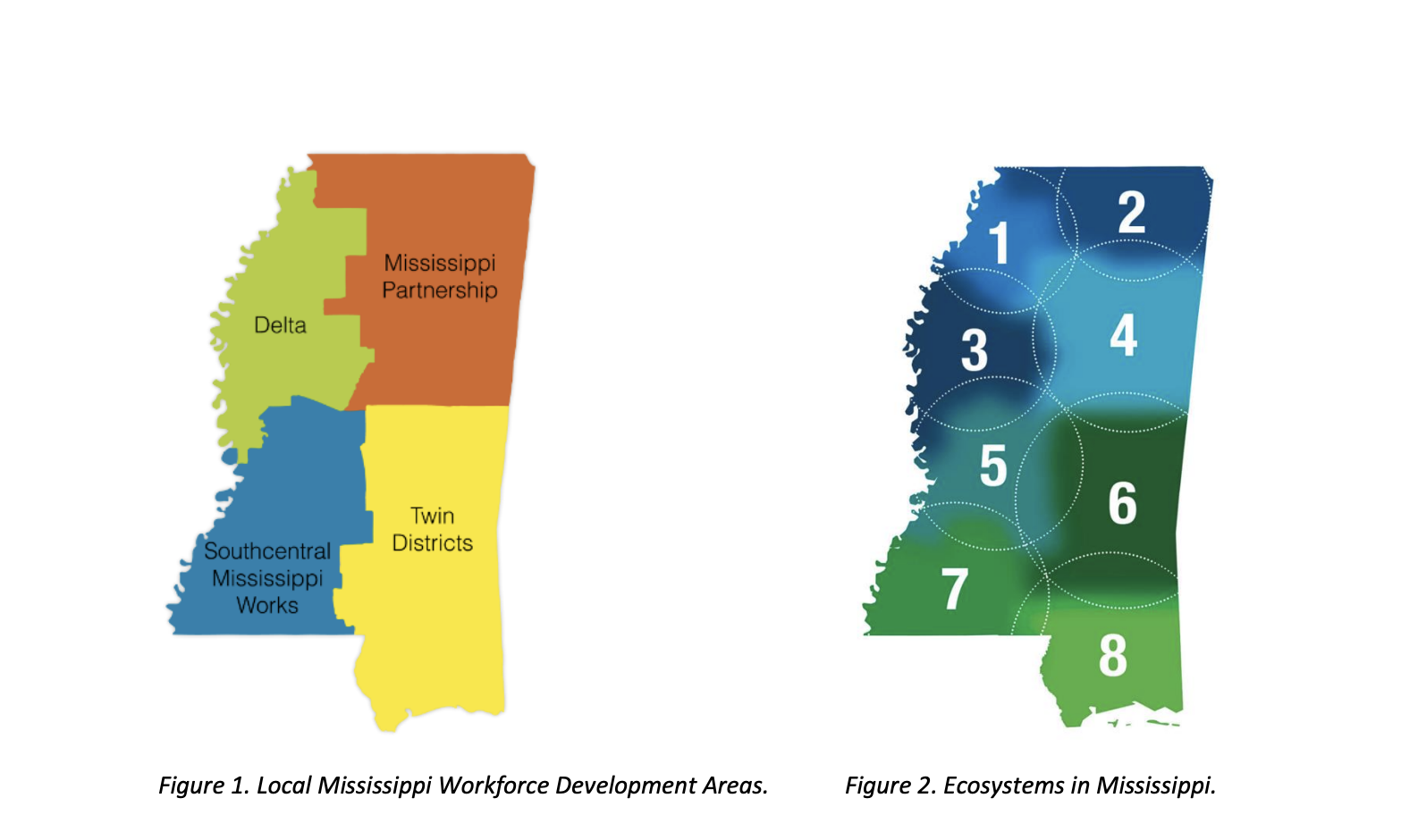
5.2. Data Sources and Analytical Framework
Priority Occupations are identified through a quantitative labor market gap analysis conducted using Lightcast labor market data. The analysis incorporates multiple labor market indicators, including:
- Real-time job postings data
- Occupational employment projections
- Regional and statewide employment trends
- Wage and earnings data
- Workforce supply indicators, including training pipeline capacity
AccelerateMS analysts extract occupational employment data for each workforce ecosystem and evaluate projected labor market demand using Lightcast’s annual projection model. This model incorporates:
- Current employment levels
- Projected job openings
- Labor market growth trends
- Worker retirements and occupational exits
Projected workforce demand is then compared with the current rate of workforce production generated through postsecondary education programs and workforce training systems.
This analysis produces a labor market gap measurement, representing the difference between employer demand and the available workforce supply.
For example:
If projections indicate that Mississippi will require 3,000 electricians annually, but current education and training programs produce 1,000 electricians per year, the resulting annual workforce gap equals 2,000 workers. This gap analysis identifies occupations where workforce shortages are most significant and where targeted workforce investments may produce the greatest economic benefit.
5.3. Priority Occupation Selection Criteria
The State Workforce Investment Board (SWIB) adopted a high-quality definition that supports the Workforce Innovation and Opportunity Act. The SWIB recognizes the importance of defining High-Quality Career and Technical Education (CTE) to eliminate any gaps in understanding how CTE is an essential strategy for workforce and economic development and to encourage transitioning away from low-value CTE programs. Therefore, the SWIB officially adopts the definition for High Quality CTE as programs that are: comprehensive, industry-aligned education and training system preparing individuals for high-wage, high-demand careers while supporting the state’s economic growth.
Associated programs must align with the priorities of the Mississippi State Workforce Investment Board (SWIB) and AccelerateMS, the state’s workforce development office, by emphasizing industry engagement, workforce readiness, and seamless career pathways. Mississippi requires that priority occupations be identified within, and aligned to, the priority industry sectors designated by the State Workforce Investment Board and AccelerateMS, that are on a state-maintained Priority Occupations List. The list reflects current and projected labor-market demand and wage opportunities, using data from Lightcast, which is labor market analytics software that AccelerateMS uses, including:
- Occupation in Demand (OID) tool
- Employment Outlook (projected growth), and
- Occupational Employment and Wage Statistics.
AccelerateMS applies three standardized criteria when identifying Priority Occupations.
High Demand
Occupations must demonstrate sustained employer demand within their respective workforce ecosystem.
Selection parameters include:
Up to the top 25 occupations per ecosystem based on demand and gap analysis outcomes
Occupations with fewer than ten (10) current job openings are excluded
This criterion ensures that Priority Occupations reflect active labor market demand rather than speculative or limited employment opportunities.
High Wage
Occupations must provide wages that support economic self-sufficiency. The wage threshold is benchmarked against the Living Wage for a single adult in Mississippi.
As of January 2026, the living wage threshold is $20.75 per hour
Source: MIT Living Wage Calculator (Mississippi)
This requirement ensures that Priority Occupations represent career pathways capable of supporting sustainable wages and long-term economic mobility for Mississippi workers.
High Skill
Occupations must require education or training beyond a high school diploma. Qualifying training pathways include:
- Postsecondary certificates
- Industry-recognized credentials
- Registered apprenticeships
- Associate degrees
- Bachelor’s degrees or higher
This requirement reinforces Mississippi’s workforce development strategy of expanding high-skill training pipelines aligned with industry demand.
5.4. Standardized Occupational Exclusions
To maintain methodological consistency and ensure focus on workforce development-aligned occupations, the following categories are excluded from Priority Occupation consideration:
- Managerial and supervisory occupations
- Government-specific occupations
- Retail occupations
These exclusions ensure that the methodology focuses on occupations with clear training pathways and measurable workforce pipeline development opportunities.
5.5 State Priority Occupation Designation
Following ecosystem-level analysis, occupations are evaluated for statewide significance. An occupation is designated as a State Priority Occupation if it appears on at least four (4) of Mississippi’s eight (8) workforce ecosystem priority occupation lists. This cross-ecosystem threshold ensures that statewide priority occupations reflect broad economic relevance and workforce demand across multiple regions of the state, rather than isolated or sector-specific demand.
5.6. Annual Review and Update Process
AccelerateMS conducts a comprehensive labor market analysis each January to update Mississippi’s Annual Priority Occupations list. This review ensures that workforce investment strategies remain aligned with:
- Verified employer demand
- Sustainable wage thresholds
- Workforce supply shortages
- Long-term economic development priorities
The updated Priority Occupations list serves as a foundational reference for:
- Workforce Pell program eligibility determinations
- Workforce Education Training (WET) funding prioritization
- State workforce policy alignment
- Postsecondary training program development
5.7. General State Priority Occupations
Priority Occupations represent the full list of high-demand, high-wage, and high-skill occupations identified through the AccelerateMS labor market methodology. The following occupations meet statewide demand thresholds but are not classified within the Targeted AccelerateMS Priority category.
- Registered Nurses (RN)
- Teachers
- Accountants and Auditors
5.7.1. Targeted AccelerateMS Priority Occupations ($$$)
Targeted AccelerateMS Priority Occupations are a smaller subset of Priority Occupations identified for strategic state investment and program focus.
These occupations are selected from within the broader Priority Occupations list but receive additional policy emphasis because they are:
- Critical to Mississippi’s economic development strategy
- Central to industry sector growth
- Facing severe workforce shortages
- Essential to major state initiatives or capital investments
The following occupations are identified as Targeted AccelerateMS Priority Occupations due to their critical importance to Mississippi’s infrastructure, industrial base, and workforce shortages.
- Welders
- Commercial Electricians
- Utility Line Workers
- Industrial Machinery Mechanics
- Water and Wastewater Operators
- Emergency Medical Technicians (EMT)
- Carpenters
- Heating, Air Conditioning, and Refrigeration Mechanics and Installers (HVAC)
- Plumbers, Pipefitters, and Steamfitters
- Operating Engineers and Construction Equipment Operators
- Machinists
- Licensed Practical and Licensed Vocational Nurses (LPN)
- Commercial Truck Drivers
Targeted AccelerateMS Priority Occupations and Emerging Occupations are eligible for prioritization in Workforce Education Training (WET) funding administered by AccelerateMS.
5.8. Executive Summary
The 2026 State Priority Occupations reflect strong cross-sector workforce demand across healthcare, skilled trades, infrastructure, utilities, and transportation sectors.
The concentration of Targeted AccelerateMS Priority Occupations within applied technical and infrastructure-critical fields underscores Mississippi’s strategic focus on expanding workforce capacity in sectors essential to economic growth and industry competitiveness.
Through this structured and data-driven methodology, AccelerateMS ensures that workforce investments, including Workforce Pell program approvals, are aligned with verified labor market demand, sustainable wages, and long-term economic development priorities across Mississippi.
6.1. Requirements
Under the definition of an “educational program” in 34 CFR 600.2, in order to qualify for any type of title IV, HEA program funds, a program must lead to “an academic, professional, or vocational degree, or certificate, or other recognized educational credential . . .” BUT, this institutional credential is not necessarily the same as the “recognized postsecondary credential”, as defined in § 690.93(a)(3) and added by § 83002(b) of the OB3 that federal Workforce Pell programs fall under. These may require additional components beyond academic coursework.
Example:
- Occupational licensure is typically not granted by educational institutions. Instead, it is issued by a Federal, State, or local government entity, licensing board, or professional association.
- The education provided through an eligible program may satisfy only the educational requirements for licensure, not the full set of requirements (such as passing an exam or completing supervised experience).
- Registered Apprenticeship programs include both a related instruction component (which may be delivered through an eligible workforce program) and a significant on-the-job training component, often completed over multiple years with an employer.
Therefore, in situations where an eligible workforce Pell program provides the educational portion required for a recognized postsecondary credential—but does not fulfill all requirements (such as work experience or licensure exams)—the program is still considered to lead to a recognized postsecondary credential under proposed § 690.93(a)(3)(I). This is because completing the educational component is a necessary step toward obtaining the full credential.
While federal statute does not prescribe a specific certificate format, institutions must ensure that credential documentation includes sufficient detail to demonstrate compliance, including:
- Program of Study
- Occupation-aligned competencies attained
- Aligned to occupations or industry sectors
- Demonstrated labor market value (e.g., employer validation, industry alignment)
- Connection to stackable academic and career pathways
- Instructional hours and rigor
The following elements are required for the State to verify that the credential meets the federal definition of a recognized postsecondary credential and supports Workforce Pell eligibility.
6.1.1. Criteria for Stackability
Workforce Pell-eligible credentials must demonstrate that their programs lead to additional credentials, including credit-bearing pathways, and have broad employer recognition that supports advancement within a career pathway.
Programs are considered stackable if there is evidence of alignment to additional credentials within one or more established career pathways, unless the program prepares students for employment in an occupation for which there is only one recognized postsecondary credential. The evidence must prove alignment to additional credentials, whether offered by the same institution or another institution of higher education, by demonstrating acceptance for credit in transfer towards meeting specific credential or program requirements.
6.1.2. Criteria for Portability
A credential may be determined to be portable if one or more of the following are documented:
- Recognition by multiple employers within an eligible occupation, such as established through related Workforce Pell employer validation requirements;
- Status as an industry-recognized credential, as established through recognition such as the recognized postsecondary credential, as defined by WIOA or other evidence;
- Evidence from labor market information indicating broad occupational relevance; or
- Connection to additional credentials, if available.
6.1.3. Evidence and Data Sources
In determining credential stackability and portability, the state may consider:
- Real-time and longitudinal labor market information;
- Employer validation submitted under the Workforce Pell Employer Validation section;
- Provider-submitted documentation of career pathway alignment; or
- Evidence from the Career and Technical Education Advisory Board for the occupation
6.2. Workforce Pell Academic/Transfer Credit
The Governor (or designee) must determine that an eligible workforce program, (690.93(b)(1)(iv)) states, “ensures that a student receives academic credit for the program for at least one certificate or degree program at one or more eligible institutions.” The pathway must be specific, transparent, and tied to the student’s ability to progress academically beyond the approved Workforce Pell program.
The purpose of this policy is to establish the requirements for institutions to establish that an eligible workforce program will ensure the award of academic credit toward a certificate or degree program upon a student’s successful completion of the eligible workforce program and enrollment in such certificate or degree program.
Institutions must document a clearly defined and operational pathway through which students can continue into further postsecondary education.
The related program may be offered by the same institution or another institution. Institutions must document:
- The specific related program
- The mechanism through which academic credit or advanced standing is awarded
- Alignment of competencies to coursework or credential requirements
Institutions may demonstrate compliance using one or more of the following:
- Articulation Agreements (formal or informal)
- Transfer-of-credit agreements
- Program-to-degree pathway maps
- Course equivalency mapping or competency alignment documentation
- Prior Learning Assessment (PLA)
- Embedded credit models
- Stackable credential pathways showing progression
6.2.1. Evidence and Data Sources
In determining whether academic credit requirements have been met, institutions should submit all documentation, as applicable:
- Articulation agreement or MOU;
- Course-to-course or program-to-program crosswalk;
- Catalog language showing transfer or stackable credential applicability;
- Identification of receiving institutions;
- Prior Learning Assessment (PLA) opportunity
- Embedded credit models
- Explanation of how students are informed of articulation options; and
- Evidence that the articulated credit applies toward a credential, not merely elective credit.
A guarantee of universal transfer is not required; however, the pathway must be specific, documented, and operational.
Evidence of these agreements includes, but is not limited to, articulation agreements, transfer-of-credit agreements, consortium or partnership agreements, documentation demonstrating agreement with Registered Apprenticeship programs, program plans, or other similar formal arrangements.
Examples
Example 1: Same Institution Credit Pathway
A noncredit Workforce Pell welding program leads to enrollment in an Associate of Applied Science in Welding Technology at the same institution. Upon enrollment, students are awarded 12 credits toward the degree based on completed competencies.
Example 2: PLA-Based Credit Award
A healthcare Workforce Pell program aligns with an Allied Health degree. Students who enroll complete a prior learning assessment process and may earn 6–9 credits based on demonstrated competencies.
Example 3: Articulated Pathway
A Workforce Pell IT program is mapped to a partner institution’s cybersecurity degree program, where identified coursework aligns and credit may be awarded through established articulation or evaluation processes.
6.2.2. Corrective Action
Programs found to be misaligned with these requirements may be required to submit updated validation or may be subject to corrective action, up to and including the denial or removal of Workforce Pell eligibility.
6.3. Proprietary (For-Profit) Institutions – Articulation Requirements
Proprietary institutions must demonstrate that academic credit earned within the proposed Workforce Pell program is reasonably transferable and applicable toward a recognized postsecondary credential at another accredited institution or within a clearly defined internal academic progression pathway.
Because proprietary institutions are not part of a statewide public articulation system, they must provide affirmative, documented evidence of transferability. General statements indicating that credit “may transfer” or that transfer is “at the discretion of the receiving institution” are not sufficient to meet this requirement.
To satisfy articulation requirements, proprietary institutions must demonstrate one or more of the following:
Formal Articulation Agreements
Executed agreements with one or more regionally or nationally accredited institutions that explicitly recognize the transfer and application of program coursework toward a credential.
Course-Level or Program-Level Crosswalks
Documented equivalencies showing how coursework aligns with programs at receiving institutions and contributes toward credential completion.
Stackable Credential Pathways (Internal or External)
Clearly defined pathways demonstrating how the program leads to a higher-level credential either within the institution or through transfer to another institution.
Documented Transfer History or Acceptance Evidence
Evidence that credits from the program have been accepted and applied toward credentials at other institutions, where available.
Programs must demonstrate that:
- Articulated credit applies toward core or major program requirements, not solely elective credit;
- Receiving institutions are identified and accessible to students; and
- The pathway results in meaningful academic progression, not duplicative coursework.
The Workforce Pell Program Determination Process establishes how programs are submitted, reviewed, approved, and published for Workforce Pell Grant eligibility. This process ensures transparency, consistency, and timely access for institutions, students, and employers.
7.1. Submission Window
The secure data file transfer portal opens June 1, 2026. Providers must submit the MS Workforce Pell application and all required documentation by 12:00 p.m. on June 30, 2026.
Using secured account credentials, complete and upload the following required documents to the corresponding secure folders for each program applying for Workforce Pell 2026-27:
- Completed MS Workforce Pell 2026-27 Attestation
- Signed MS Workforce Pell Employer Validation form (three per program)
- Evidence of stackability/portability
- Data Submission Template
7.2. Submission Requirements and Review
7.2.1. Initial Completeness Review
After submission, AccelerateMS reviews applications to confirm:
- All required documentation is included
- Institutional eligibility
- Any missing, inconsistent, or unclear information
Applicants will receive one of the following notifications:
- Complete – Application moves to full review
- Incomplete – Applicant receives 10-day window to correct deficiencies
7.2.2. Program Quality and Eligibility Review
Applications deemed complete move to the quality and eligibility review. Programs are evaluated on:
- Alignment with Workforce Pell Priority Occupations List
- Program length meeting statutory requirements
- Demonstrated employer alignment
- Transparent cost structure
- Evidence of stackable, portable credentials
7.2.3. Determination Phase
Once quality and eligibility requirements are met, AccelerateMS issues a final recommendation to Mississippi
Governor’s Office for official certification. Determination outcomes include:
- Approved – Program meets all Workforce Pell requirements
- Provisionally Approved – Minor issues require follow-up
- Rejected – Program does not meet statutory or quality standards
Applicants receive electronic determination letters, including rationale and guidance for resubmission when applicable.
7.3. Appeals Process
Institutions may appeal program denials within 30 days; AccelerateMS convenes a review panel and issues a final determination.
7.4. Governor’s Certification and Submission
7.4.1. State Certification
The Governor’s designated agency, Accelerate MS, in consultation with the SWIB, must certify eligible programs and submit a formal list of approved Workforce Pell programs and attestations to the U.S. Department of Education (ED). ED then performs a verification of the 70% program completion rate, 70% program job placement rate, and Value-Added Earnings standard before final approval. This process will be completed annually.
7.4.2. Public Posting
AccelerateMS will publish the current list of Mississippi-certified Workforce Pell programs annually on its website, within 30 days after ED’s final approval of the Governor-certified program list. Published information will include the program name, provider, credential type, CIP/SOC alignment, tuition and fees, and other disclosures required by state or federal law.
Mississippi measures Workforce Pell program outcomes using verified administrative data rather than institutional self-reported results. Institutions submit participant enrollment and completion records, which the State matches with unemployment insurance wage records through the State Longitudinal Data System (SLDS) to determine completion, employment, and earnings outcomes.
Programs must meet three federal performance standards to remain eligible:
- 70 percent completion within 150 percent of program length
- 70 percent employment in the second full quarter after exit
- Earnings that demonstrate economic value relative to program cost
8.1. State Data Infrastructure
Mississippi maintains a mature SLDS that securely links education and workforce records across multiple state agencies. This integrated data infrastructure enables the State to track participant outcomes from program enrollment through employment using verified administrative data.
Institutional enrollment and completion records submitted by Workforce Pell providers are matched with employment and earnings records derived from the UI wage reporting system, which consists of administrative records reported quarterly by employers showing wages paid to workers.
To capture employment outcomes for individuals who work outside of Mississippi, the State also uses the SWIS. SWIS supports the administration of federal programs by enabling participating states to exchange wage record data for qualifying individuals. Through this system, Mississippi may be able to identify out-of-state employment outcomes for program participants, consistent with SWIS participation rules.
Through the integration of these data sources, Mississippi can produce reliable measures of program completion, employment outcomes, and earnings growth. This infrastructure allows Workforce Pell program performance to be evaluated using consistent statewide standards while minimizing additional reporting requirements for institutions.
8.2. Measurement Principles
Outcome calculations are performed using privacy-protected administrative datasets within Mississippi’s SLDS. Individual-level earnings records remain confidential and are used only to produce aggregated program-level performance measures for program evaluation and accountability.
This framework provides a consistent statewide methodology for measuring Workforce Pell program outcomes while minimizing additional reporting requirements for institutions.
All calculations described in this framework are implemented consistently with applicable federal Workforce Pell statutes, regulations, and guidance issued by the U.S. Department of Education.
8.3. Data Collection
Workforce Pell outcome measurement begins with the collection of participant-level program data from institutions offering eligible programs. Institutions must submit a complete participant record for each individual enrolled in a Workforce Pell program.
Participant records provide the foundational information required to measure program completion, employment outcomes, and earnings. These records are securely transmitted to the State and integrated into Mississippi’s SLDS.
Institutions report only the information necessary to support outcome calculations. Employment and earnings outcomes are calculated by the State using administrative wage records.
Each participant record must include the following core elements:
Participant Identifiers
- SSN
- First name
- Last name
- Date of birth
These identifiers are required to match participant records with administrative wage data used to measure employment and earnings outcomes.
Program Enrollment Information
- Program identifier
- Date entered program
- Completion status
- Completion date
- Credential attained
Program Cost Information
- Tuition charges
- Required feed
Withdrawal Information (If applicable)
- Last date of attendance
- Basis for withdrawal
Institutions must identify statutory exclusions when reporting withdrawal information. Statutory exclusions include participants who die, experience a disabling medical condition that prevents employment, enter active military service for more than 30 days, or become incarcerated. Participants meeting these conditions are excluded from completion and employment rate calculations.
8.3.1. Program Exit Definition
Institutions do not report a program exit date. For outcome measurement, program exist is defined as the participant’s completion date or last date of attendance, whichever occurs first.
8.4. Data Integration
After institutional participant records are collected, the State integrates these records with administrative wage data to measure employment and earnings outcomes. Data integration occurs within Mississippi’s SLDS, which securely links education and workforce datasets.
Participant identifiers provided by institutions are used to match program enrollment records with the administrative wage record datasets described in the State Data Infrastructure section.
These records allow the State to determine whether Workforce Pell participants are employed after completing training and to calculate their post-program earnings.
Interstate wage records may be incorporated through SWIS, as described above.
Following the matching process, the combined institutional and wage record dataset is used to calculate program-level outcome indicators. Individual-level earnings records remain confidential and are used only to produce aggregated statistics for program evaluation and reporting.
8.5 Federal Workforce Pell Performance Measures
Workforce Pell programs are evaluated using three core outcome measures required under federal Workforce Pell accountability standards. These measures assess whether programs produce successful completion outcomes, lead to employment, and generate measurable economic value for participants.
These measures reflect the performance thresholds established under Workforce Pell program eligibility requirements and are used to determine whether training programs remain eligible to participate in the program.
Each outcome measure is calculated using the standardized cohort and wage record methodology described in the Measurement Methodology section.
8.6. Completion Rate
Purpose
Measures the percentage of participants who successfully complete the program and earn the intended credential.
Calculation

Measurement Timing
Completion is evaluated within 150 percent of the program’s normal length.
Methodology
The completion rate is calculated by dividing the number of participants who earn the recognized postsecondary credential associated with the program by the Adjusted Cohort Size.
Adjusted Cohort Size equals the total number of participants who entered the program during the specified award year minus statutory exclusions.
Statutory exclusions include participants who die, experience a disabling medical condition preventing employment, enter active military service for more than 30 days, or become incarcerated.
Standard
Programs must achieve a completion rate of at least 70 percent within 150 percent of the normal time to completion.
8.7. Employment Rate
Purpose
Measures whether program completers obtain employment following program exit.
Calculation

Measurement Timing
Employment is measured using the second full calendar quarter following program exit.
Methodology
Employment outcomes are determined by matching participant records with administrative wage data. Mississippi uses unemployment insurance wage records through the SLDS and, where available, interstate wage records through the SWIS.
A participant is counted as employed if wage records show positive wages (greater than $0) during the second full calendar quarter following program exit.
Participants without matching wage records during the measurement quarter are treated as not employed for purposes of the employment calculation.
Standard

Programs must achieve an employment rate of at least 70 percent.
8.7.1. Economic Value: 1-Year Benchmark
Purpose
Determines whether program earnings outcomes justify the cost of training for participants and taxpayers.
Calculation

Measurement Timing
Economic value indicators are measured one year after program completion, with an additional long-term benchmark measured three years after completion.
Methodology Median annualized earnings of program completers are compared to 150 percent of the federal poverty line for a single individual.
Standard
A program meets this benchmark if value-added earnings exceed the total tuition and required fees charged:
8.7.2. Economic Value: 3-Year Benchmark
Purpose
Evaluates long-term earnings outcomes relative to a high school baseline.
Calculation
Measurement Timing
Measured three years after program completion.
Methodology
A new annualized earnings measure is constructed using the four consecutive quarters beginning three years after program completion. Median earnings are calculated for the same cohort using this later measurement period and compared with the state median earnings of individuals with only a high school diploma.
The high school comparison group consists of individuals in Mississippi whose highest level of education is a high school diploma. The comparison uses the statewide median earnings for this population, based on administrative wage data aligned to the same measurement period as the Workforce Pell cohort.
Standard
A program meets the economic value requirement if median earnings exceed the state median earnings of individuals with only a high school diploma for at least two of the three most recent award years.
8.8. Measurement Schedule
Outcome calculations occur after sufficient administrative wage data become available and within the statutory timeframes required for Workforce Pell performance measurement. Because wage records are reported quarterly by employers, results can only be calculated once the required wage record data become available.
8.8.1. Completion Outcomes
Completion rates are calculated after the conclusion of the 150 percent program completion window. This allows sufficient time for participants to complete the program within the federally permitted completion period.
8.8.2. Employment Outcomes
Employment placement outcomes are measured using wage records from the second full calendar quarter following program exit. Due to the quarterly reporting cycle of unemployment insurance wage records and standard administrative data processing timelines, employment outcomes are typically calculated approximately 12 months after program completion.
8.8.3. Economic Value: 1-Year Benchmark
The value-added earnings metric requires the construction of annualized earnings from four consecutive quarters of wage data beginning after the first full quarter following program exit. Because these data must accumulate before analysis, the one-year economic value metric is typically calculated approximately 21 months after program completion.
8.8.4. Economic Value: 3-Year Benchmark
The high school earnings comparison requires the construction of annualized earnings beginning three years after program completion. Because this benchmark relies on long-term earnings data, the three-year economic value measure is typically calculated approximately 45 months after program completion, based on administrative data availability and reporting cycles.
These timelines reflect the time required for wage record reporting and ensure that program outcomes are measured using complete and verified administrative data.
Federal Workforce Pell rules require that job placement outcomes eventually be measured based on employment in the occupation or industry for which a program prepares students. During the initial implementation period, programs may satisfy the placement requirement by demonstrating that participants obtain employment during the second quarter after program exit.
Beginning in later award years, the federal standard will require that employment outcomes be measured based on whether program completers are working in the occupation for which the training program prepares them, or in a comparable high-skill, high-wage, or in-demand occupation.
Standard UI wage records used for outcome measurement do not currently include occupational classification information such as Standard Occupational Classification (SOC) codes. As a result, additional data sources will be required to identify the specific occupations in which program completers are employed.
To support this future requirement, Mississippi will evaluate options for augmenting existing administrative data systems with occupational information. Potential approaches may include employer-reported occupational enhancements to wage records, integration with additional administrative workforce datasets, or the use of supplemental labor market information systems.
Consistent with federal law, the Governor retains full discretion to determine that a program is not eligible for certification and may withdraw or decline certification at any time. A program’s state certification also expires upon the expiration of the eligible institution’s Program Participation Agreement (PPA). Similarly, ED may remove a program from federal Workforce Pell eligibility if it does not meet verification requirements, outcome metrics, or other federal standards.
AccelerateMS will update the public posting within 30 days of any program being removed from eligibility due to state or federal action.
Adjusted Cohort Size: Total number of participants in the cohort minus those excluded under federal rules (e.g., death, disability, military service, incarceration).
Annualized Earnings: Total wages summed across four consecutive quarters following program exit.
Career Pathways: Career Pathways to mean a combination of rigorous and high-quality education, training, and other services that: a. aligns with skill needs of industries in the state or regional economy b. prepares an individual to succeed in secondary or postsecondary education options c. includes counseling to support the individual’s education and career goals d. includes, education offered concurrently with and in the same context as workforce preparation activities and training for a specific occupation or occupational cluster e. organizes education, training and other services to support the particular needs of an individual to accelerate their educational and career advancement f. helps an individual enter or advance within a specific occupation or occupational cluster.
Cohort: Group of participants who enter a program during a given award year and are tracked for outcome measurement. Each participant is assigned to a single cohort based on initial program entry.
Eligible Institution: An institution is a Title IV-eligible, accredited postsecondary institution authorized to operate in Mississippi or serving learners located in Mississippi and offers one or more programs meeting federal requirements.
Eligible Workforce Program: Program of 150-599 clock hours delivered over at least 8 weeks but no more than 14 weeks that meet governor-approved, federally defined quality requirements.
Family Sustaining Wage: The family-sustaining wage is derived from Mississippi’s Cost of Living Tool, which estimates the cost of meeting basic needs using federal and state data. The family-sustaining wage reflects a typical Mississippi household of three people, with one full-time worker and one part-time worker, and represents the hourly wage needed to cover basic living costs regardless of how work hours are distributed between adults.
Median Earnings: The midpoint of earnings for all participants in a cohort.
Portable Credential: A credential is considered portable when it is recognized and accepted as verifying the qualifications of an individual in other settings— such as other geographic areas across the country, other educational institutions, or other industries or businesses.
Program Exit: The participant’s completion date or last date of attendance, whichever occurs first
SLDS: State Longitudinal Data System
SSN: Social Security Number
Stackable Credential: A credential that prepares students to pursue one or more certificate or degree programs at one or more institutions of higher education (which may include the eligible institution providing the program).
SWIS: State Wage Interchange System
UI: Unemployment Insurance
Value‑added earnings (VAE): Adjusted median earnings three years after completion minus 150% of the Federal Poverty Guideline; published tuition/fees must be <VAE (beginning 2029-30 award year).
Need a summary sentence and a list of partners, committee members, etc.